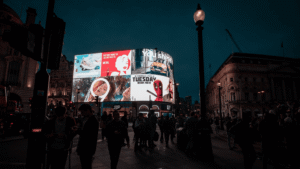
Street marketing, once viewed as a one-off guerrilla tactic, has evolved and become more sophisticated, emerging as a strategic component of today’s advertising landscape. Its ability to interact directly with the public in their everyday environment, create memorable experiences, and generate authentic word-of-mouth makes it a valuable tool for brands. As we move toward 2026, new trends are emerging, driven by technological advances, changing consumer behaviors, and a heightened awareness of societal issues. This article explores these key trends that will shape street marketing in the coming years and analyzes how brands can leverage them to innovate and effectively engage their audiences.
The Increasing Integration of Digital and Technology
The line between the physical and digital worlds is blurring, and street marketing in 2025 will be characterized by even greater technological integration, offering enriched and personalized experiences.
Phygital at the Heart of the Street Experience
The concept of “phygital”—the fusion of the physical and digital worlds—will become a cornerstone of street marketing. The use of technologies such as QR codes will allow passersby to scan posters or installations to instantly access additional information, special offers, or interactive online content. NFC (Near-Field Communication) technology will facilitate contactless interactions, such as downloading apps or participating in contests, simply by holding a smartphone near a physical touchpoint. Augmented reality (AR) will transform the urban environment into an interactive playground, allowing brands to overlay virtual elements onto reality via dedicated mobile apps, creating immersive and playful experiences. Mobile interactive kiosks and touchscreens temporarily installed in strategic locations will offer opportunities for direct engagement, data collection (with consent), and the presentation of captivating multimedia content.
Advanced Personalization and Geolocation
Thanks to advances in data and geolocation (always in compliance with privacy laws and regulations), street marketing in 2025 will become even more relevant and targeted. Brands will be able to deliver hyper-localized messages based not only on consumers’ geographic location but also on their preferences and behaviors (derived from ethically collected data). Imagine receiving a special offer for a nearby coffee shop just as you walk by, or an invitation to an event that matches your interests. Leveraging contextual data—such as the weather or local events—will enable real-time personalization of interactions, making messages more relevant and engaging.
The Use of Artificial Intelligence (AI)
Artificial intelligence (AI) will play an increasingly important role in optimizing and personalizing street marketing campaigns. Chatbots and virtual assistants will be able to interact with the public via screens or apps, answering their questions, providing information, and guiding their actions. AI will also be used toanalyze foot traffic and passerby behavior, enabling brands to optimize the location and timing of their activations to maximize their impact. Finally, AI could enable the creation of dynamic, adaptive content based on real-time audience reactions, making campaigns even more interactive and engaging.
Experience and Commitment at the Heart of Our Strategies
Beyond simply conveying messages, street marketing in 2025 will focus on creating memorable experiences and establishing an authentic connection with the public.
Immersive Experiential Marketing
Brands will seek to create events and interactive installations that engage the senses and immerse the public in their world. These immersive experiences—ranging from impromptu mini-concerts to interactive art installations—will aim to leave a lasting impression and generate positive emotions associated with the brand. Storytelling will become a key element, transporting the audience into a captivating narrative. Collaborations with street artists and performers will increase to create original and spectacular activations that surprise and delight passersby.
The Importance of Community Building and Social Bonds
In 2025, street marketing will go beyond simply capturing people’s attention; it will seek to build connections and foster the formation of communities around brands.Organizing participatory and inclusive events that encourage dialogue and interaction among participants will become a key strategy.Encouraging sharing on social media and the creation of user-generated content (UGC) will be essential to amplifying the reach of campaigns and reinforcing their authenticity. Partnerships with local influencers who are closely connected to their communities will make it possible to reach a targeted audience in a more credible and engaging way.
Fun and Gamified Street Marketing
The incorporationof game elements (urban scavenger hunts, interactive challenges, contests) into street marketing campaigns will become a major trend in 2025. Gamification will help boost audience engagement and participation in a fun and entertaining way. Brands will use game mechanics to reward interaction, loyalty, and sharing, thereby creating a positive and memorable experience.
Ethics and Responsibility at the Heart of Our Concerns
Against a backdrop of growing awareness of environmental and social issues, street marketing in 2025 will need to incorporate ethical and responsible considerations.
Sustainable and Eco-Friendly Street Marketing
The use of recycled and biodegradable materials for displays and installations will become the norm. Brands will engage in efforts to raise awareness of environmental and social issues through their street marketing campaigns. Offsetting the carbon footprint of street marketing activities could also become more widespread, demonstrating a concrete commitment to sustainability.
Respect for Public Space and Privacy
Street marketing campaigns in 2025 will need to be more discreet and integrated into the urban environment, avoiding any excessive visual intrusion. Transparency in the collection and use of personal data, in full compliance with the GDPR and similar regulations, will be essential to gaining the public’s trust. Ethical and responsible communication, avoiding stereotypes and misleading messages, will be imperative.
Positive Social Impact and Community Engagement
Brands will increasingly seek to make a positive social impact through their street marketing efforts. Partnerships with local organizations and social initiatives will become more widespread. Campaigns will highlight important causes and engage in initiatives that support communities, thereby helping to create added value for the urban environment and its residents.
Street Marketing in 2025: Conclusion
Street marketing in 2025 is shaping up to be a dynamic and rapidly evolving field, characterized by increased technological integration, a focus on experience and engagement, and a commitment to ethics and responsibility. Brands that can anticipate these trends and integrate them creatively and authentically into their strategies will be the ones that succeed in capturing attention, building lasting connections with their audience, and standing out in an ever-evolving advertising landscape. The future of street marketing lies in its ability to combine innovation, relevance, and responsibility to create memorable and meaningful experiences at the heart of urban life.