Why use an advertising agency for street marketing?
By its very nature, street marketing takes place in public spaces, which are complex and heavily regulated environments. For a brand seeking to make a lasting impression and effectively reach its target audience on the street, working with a specialized advertising agency can be not only a wise move, but often essential.
Issues related to visibility and local or national distribution
Whether the goal is to increase visibility at the neighborhood or city level, or to launch a nationwide street marketing campaign, logistics and local knowledge are essential. An advertising agency has the expertise and network needed to identify strategic locations, negotiate space, and ensure optimal delivery of the message.
Need an expert to coordinate media efforts
Street marketing is not limited to simply handing out flyers. It encompasses a variety of media and techniques, from mobile billboards to event-based campaigns and digital out-of-home (DOOH) advertising. An advertising agency acts as a conductor, coordinating the various media to create a cohesive and impactful campaign.
What is an advertising agency?
Definition
An advertising agency is a company whose primary business is selling advertising space on behalf of various media outlets. It acts as an intermediary between advertisers (brands seeking to promote themselves) and the owners of advertising space (municipalities, transportation companies, shopping centers, etc.).
The Difference Between Media Buying and a Communications Agency
It is important to distinguish between a media buying agency and a communications agency:
- Media Agency: Focuses on selling specific advertising spaces that it manages. It has expertise in the media platforms it markets and their audiences.
- Communications Agency: Offers a broader range of services, including the development of communication strategies, the creation of advertising messages, the purchase of advertising space (through advertising agencies or directly), and campaign monitoring.
In the context of street marketing, an agency may engage one or more agencies to handle the operational implementation of the campaign on the ground.
Types of advertising agencies: local, national, specialized (billboard, digital, transit, etc.)
Ad networks can be distinguished based on several criteria:
- Geographic area: Some agencies operate at the local or regional level, while others have national or even international coverage.
- Media Types: Some advertising agencies specialize in a specific type of media, such as static outdoor advertising (billboards, street furniture), mobile outdoor advertising (buses, taxis), digital out-of-home (DOOH), or tactical street marketing media.
The Role of an Agency in a Street Marketing Campaign
Management of Advertising Space (Urban, Mobile, Event-Based)
The advertising agency makes its inventory of advertising spaces available to advertisers. For street marketing, this may include:
- Urban spaces: Locations on street furniture (bus shelters, advertising columns), traditional billboards, and high-traffic pedestrian areas.
- Mobile advertising spaces: Advertising space on buses, trams, subways, taxis, and sometimes even vehicles specifically designed for advertising.
- Event spaces: Booths, temporary displays at events, festivals, and trade shows.
Logistics Coordination and Permits
Launching a street marketing campaign often involves administrative procedures and complex logistical coordination. The agency can handle:
- Applications for permits from municipalities and the relevant authorities.
- Planning and managing the installation and removal of advertising displays.
- Organizing the distribution of flyers, samples, or other on-site activities.
- Management of teams of facilitators or staff for event operations.
Strategic advice: targeting, catchment areas, timing
Beyond simply selling advertising space, an experienced advertising agency can provide genuine strategic advice:
- Identification of relevant catchment areas based on the campaign's target audience.
- Recommendation of the most appropriate media for reaching this target audience.
- Optimizing the campaign schedule based on local events, peak periods, etc.
- Analysis of the potential impact of the various locations.
The channels offered by advertising agencies
Traditional Advertising
- 4×3 billboards: Maximum visibility on major roads and in high-traffic areas.
- Bus shelters: Targeting public transit riders and passersby.
- Street furniture: Morris columns, pole-mounted signs, and advertising benches for a presence in the heart of cities.
Discover OOH advertising with 10STRICT right HERE
Mobile Display and Transportation
- Buses, subways, trams: High visibility of the message among a diverse urban audience.
- Taxis: Focusing on downtown areas and tourist areas.
- Company Cars: Corporate fleets transformed into mobile advertising platforms.
Tactical Media in Street Marketing
Some advertising agencies offer solutions specifically tailored to street marketing:
- Stickers and authorized flyposting: Use of adhesive materials in designated areas with the necessary permits.
- Light projections: Displaying messages or logos on buildings or public spaces.
- Events: Advertising space at events, booths, brand activations.
DOOH (Digital Out-of-Home)
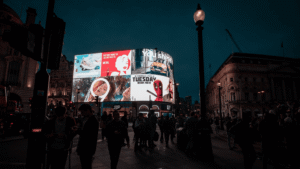
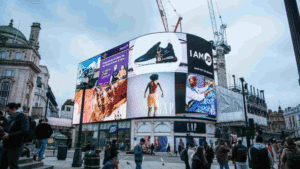
- Digital screens in city centers or train stations: Flexible messaging, dynamic content delivery, and the potential for interactivity and contextual targeting.
Discover digital out-of-home (DOOH) advertising with 10STRICT right HERE
Web & Mobile Add-ons
Some advertising agencies are incorporating digital solutions to amplify the impact of street marketing campaigns:
- Geotargeted campaigns (mobile advertising): Targeting smartphone users located near ad display areas.
- Drive-to-store campaigns: Encouraging in-store visits through OOH messages and geotargeted offers.
- Social Media Support: Promoting street marketing campaigns on social media platforms.
Steps for Working with an Advertising Agency
Briefing
The advertiser explains its objectives, target audience, budget, and constraints to the advertising agency.
Media Recommendation
The advertising agency proposes a selection of media and placements tailored to the brief, supporting its choices with audience and traffic data.
Selecting and Reserving Campsites
The advertiser approves the proposed ad placements, and the advertising agency proceeds to reserve them.
Campaign Tracking and Reporting
The agency ensures the campaign runs smoothly (posting posters, distribution, etc.) and provides performance reports (number of impressions, estimated foot traffic, photos of the displays).
What criteria should you use to choose the right advertising agency?
Geographic or Sector-Specific Specialization
Choose an agency with a strong local presence for a targeted campaign, or one with industry expertise if the brand operates in a specific field.
Access to innovative tactical resources
If the street marketing strategy relies on original initiatives, make sure the agency offers creative and tailored solutions.
Responsiveness, strategic guidance, transparency
Choose an advertising agency that is responsive, capable of providing genuine support, and transparent about costs and performance.
Real-world examples: street marketing campaigns managed by an agency
Product launch in several cities
A beverage brand has hired a national advertising agency to coordinate bus shelter advertising and the distribution of samples in the downtown areas of 10 major metropolitan areas. The agency handles permits, distribution logistics, and campaign monitoring.
Event campaign centered around a festival or a shopping mall
A festival organizer works with a local advertising agency to place posters on street signs near the venue, set up advertising booths at the event site, and display messages on the DOOH screens at the partner shopping center.
Multi-platform campaign: outdoor advertising + distribution + DOOH
A fashion retailer combines traditional advertising on busy streets with the distribution of promotional flyers by street marketing teams coordinated by the advertising agency, and runs targeted ads on DOOH screens located near its stores.
Budget and Profitability: How Much Does an In-House Campaign Cost?
Pricing based on location, duration, and format
Rates vary considerably depending on the visibility of the location, the duration of the campaign, the format of the advertising medium (size, type), and the volume of foot traffic or vehicle traffic.
Overhead costs + production of materials
The overall budget includes the costs of renting advertising space billed by the advertising agency, as well as the production costs for promotional materials (printing posters, creating DOOH content, manufacturing giveaways for distribution, etc.).
Performance Metrics (impressions, traffic, interactions)
The advertising agency can provide estimates of the number of impressions (the number of times the message is likely to be seen) and foot traffic data (the number of people passing by the location). For DOOH, interaction metrics may also be available.
Conclusion: Why Is an Agency an Essential Tool for Effective Street Marketing?
For an ambitious and well-orchestrated street marketing campaign, working with an advertising agency is a strategic investment. Its on-the-ground expertise, network of locations, ability to manage complex logistics, and sound advicehelp optimize visibility, effectively reach the target audience, and maximize return on investment. The agency acts as a key partner, transforming creative ideas into concrete and impactful actions in public spaces.